


The first half of 2026 has been one of the more difficult periods for international education. I have done dozens of presentations, and the majority of them delivered important but difficult messages.
Student numbers are falling in several of the traditional study destinations.
Governments are intervening more directly in international student flows. Visa policies have tightened, geopolitical tensions remain elevated, and affordability continues to influence family decisions. Everyone has heard about this by now.
Looking only at headline enrolment and visa numbers, it would be easy to conclude that international student demand is weakening.
I do not think that is the full story.
What we are seeing is a growing gap between demand for international education and the ability of destinations to convert that demand into actual student arrivals.
At the same time, something equally important is happening: students have more credible alternatives than they did in the past.
That combination is changing international student mobility.
 Source: English Education Ireland Conference 2026
The traditional study destinations are no longer moving together
For many years, we became accustomed to discussing Australia, Canada, the United Kingdom and the United States collectively as the major English-speaking destinations.
In 2026, that makes increasingly little sense.
Canada is experiencing the clearest structural adjustment
The government has deliberately reduced international student intake as part of its broader objective to lower the temporary resident population. For 2026, it expects to issue up to 408,000 study permits, including only 155,000 to newly arriving international students. This represents a 7% reduction from the 2025 issuance target and 16% from 2024.
The impact is already visible. Between January and May 2026, Canada recorded only 19,425 new international student arrivals.
Canada's decline therefore cannot simply be interpreted as falling student interest. The size of the market is increasingly being determined by government policy.
Australia is experiencing a different adjustment
Between January and May 2026, 680,582 international students studied in Australia, 7% fewer than during the same period in 2025. Enrolments declined by 8% and commencements were also down 8%.
The underlying picture is much more uneven. Higher education enrolments were actually 2% higher, while ELICOS enrolments were down 27%.
The UK has so far proved more resilient
By the June UCAS deadline, there were 148,350 international undergraduate applicants, up 7% year on year. At the same time, Sponsored Study visa applications in the year ending June were down 8%.
These figures measure different populations and should not be compared directly, but together they demonstrate why I increasingly hesitate to describe a market as simply growing or declining.
Interest, applications, visas and arrivals can now point in different directions.
The United States presents perhaps the greatest uncertainty
The latest full-year Open Doors data recorded a historic high of 1.18 million international students in 2024/25. Yet IIE's subsequent Fall 2025 Snapshot recorded a 17% decline in new international enrolments.
The fundamental attractiveness of US higher education has not disappeared. What has changed is the level of uncertainty surrounding access and the wider political environment.
Geopolitics has moved into the student recruitment funnel
This is perhaps the factor I believe we still underestimate.
International education has always been affected by politics. What feels different today is the number of geopolitical developments happening simultaneously:
Russia's war in Ukraine continues.
Conflict and instability in the Middle East have affected airspace, aviation and energy markets.
Relations between China and several Western countries remain complicated.
Trade tensions have returned.
And policy developments in the United States have created questions around visas, entry and the experience international students can expect.
For a university, these may appear to be external political developments.
For a family deciding where to send an 18-year-old child for a couple of months or three or four years, they are not external at all.
They become questions about safety, accessibility and predictability:
Can my child get there easily?
Will the visa rules remain the same?
Will they feel welcome?
Can they travel home if something happens?
Will they be able to work after graduation?
Could political relations between our countries affect them?
And is it sensible to commit a significant proportion of our household savings when the economic and political environment is this uncertain?
This is important because international education involves a long decision cycle. A student making a destination decision today is not assessing only today's conditions. They are implicitly making assumptions about what that country will look like two, three or five years from now.
That makes stability itself part of a destination's value proposition.
The economic calculation is changing as well
The IMF expects global economic growth of around 3% in 2026, but the outlook remains exposed to geopolitical developments, energy prices and trade disruption.
For international education, macroeconomic movements quickly become very practical questions.
Tuition fees are only one part of affordability. Exchange rates, accommodation, food, insurance and air travel all influence the actual cost to a family.
Higher energy prices and changes to flight routes can push travel costs higher. Currency movements can make an education that looked affordable six months ago considerably more expensive. Weak employment markets can make families question whether the expected return still justifies the investment.
I would therefore be careful about saying that students are simply becoming more price-sensitive.
They are becoming more value-sensitive.
The cheapest option will not necessarily win. A more expensive education can still represent good value if the qualification is strong, the programme is shorter, employment prospects are better or the route into the labour market is clearer.
But students and parents are asking harder questions about that equation.
The other half of the story is growth
If we only follow the Big Four, however, we miss one of the most important developments in international education.
There are markets growing strongly.
Germany
DAAD1 estimates that around 420,000 international students and doctoral candidates were studying at German universities in the 2025/26 winter semester. International first-year enrolments were estimated at around 99,000, 9% higher than the previous year. Germany had already passed 400,000 international students in 2024/25, when international numbers increased by approximately 6%.
Germany combines several things that are particularly relevant in the current environment: comparatively low tuition costs at public universities, a growing English-language offer, a large economy and opportunities to remain and work after graduation.
It is not without challenges. German universities themselves identify visa procedures, housing and living costs as major barriers. But its trajectory is important because it demonstrates that international student growth is continuing where the proposition aligns with what students increasingly value.
1.DAAD, "Number of international students well over 400,000"
Ireland
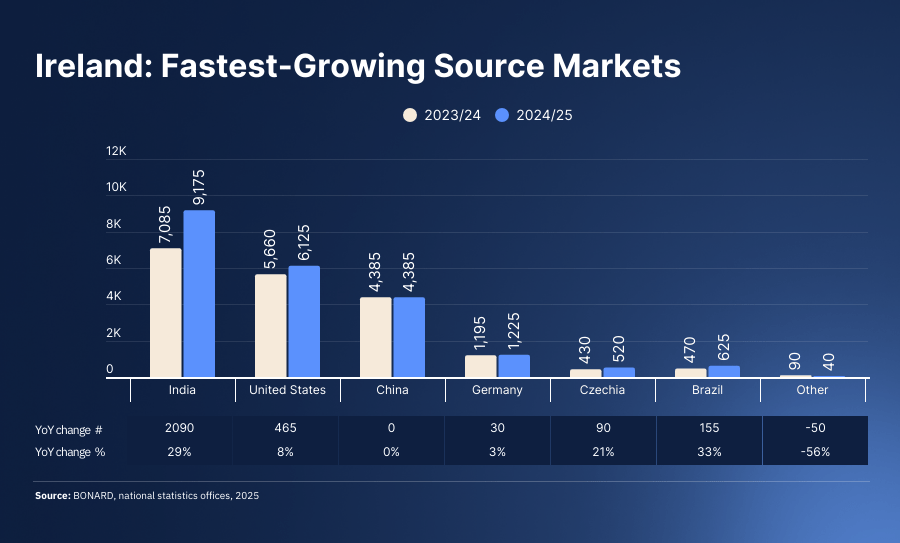
There were 44,535 non-Irish domiciled students in publicly funded higher education in 2024/25, up 10% in a single year. Non-EU students accounted for 32,940 of them, with India now the largest international source market.
Ireland has benefited from being English-speaking, European and connected to a strong multinational employment market. Its challenge is increasingly not whether it can attract international students, but whether infrastructure, particularly accommodation, can keep pace.
New Zealand
New Zealand is also moving in the opposite direction to several of its traditional competitors.
International education enrolments reached 92,580 in 2025, an increase of 11%, bringing the sector back to around 80% of its pre-pandemic peak. At tertiary level specifically, international student numbers increased 15%, from 52,145 to 59,890.
That is particularly interesting when Canada and Australia are declining.
New Zealand remains smaller, but that is almost beside the point. It shows what can happen when a destination moves in the opposite direction to competitors and combines quality with a comparatively clear message that international students are wanted.
Asia should no longer be viewed primarily as a source region
Perhaps the bigger structural change is happening in Asia.
For decades, our industry has talked about Asia predominantly in terms of students leaving China, India, Vietnam, South Korea, Japan and Southeast Asia for Western universities.
That model is changing.
Japan
Japan had 408,069 international students in May 2025, according to the latest official figures released this year. That was an extraordinary 21% increase in one year. Japanese-language institutes enrolled more than 140,000 international students, up 31%, while professional training colleges grew by 40%.
Those figures are difficult to dismiss as a niche development.
Hong Kong
Hong Kong is another market worth watching closely.
Non-local enrolment across locally accredited undergraduate-level and above programmes reached 88,914 in 2024/25, compared with 71,910 the previous year and 61,923 two years earlier. That represents growth of more than 40% in just two years.
And Hong Kong is actively creating room for further growth. From 2026/27, the ceiling for self-financing non-local students at publicly funded institutions is increasing from the equivalent of 40% of local student places to 50%.
This is almost the mirror image of what we are seeing in Canada
One government is deliberately reducing international student intake while another is deliberately increasing the capacity available to international students.
Students notice these signals.
And these are not the only alternatives. Across Asia, investment in English-medium education, international campuses and transnational education continues to expand.
The implication is important: diversification is no longer simply students moving from one Big Four country to another.
Increasingly, it can mean staying within the region.
Proximity is becoming a competitive advantage
This matters particularly in an unstable world.
A Chinese family considering Hong Kong, a Vietnamese student looking at Japan, or an Indian student considering Germany is making a different mobility calculation from a student automatically assuming that an international degree means travelling to one of four English-speaking countries.
Regional destinations can offer lower travel costs, greater proximity to family and sometimes lower overall study costs.
TNE takes that logic one step further.
Students can obtain an international qualification without undertaking traditional long-distance mobility at all.
I do not believe this will replace traditional international education. There will continue to be enormous demand for studying in London, Sydney, New York, Toronto and other established education hubs.
But it does mean that these destinations are competing against a much larger set of alternatives.
And once students become accustomed to considering those alternatives, I do not expect that behaviour simply to reverse if visa conditions improve.
H2 is likely to bring divergence rather than recovery
I would therefore be cautious about describing the second half of 2026 as either a recovery or a continued downturn.
Neither captures what is happening.
I expect greater divergence.
The UK currently appears the most resilient of the traditional major destinations. Its global brand remains strong and undergraduate demand is encouraging. However, weaker overall visa application volumes and pressure on postgraduate recruitment mean that September arrivals will be an important indicator.
Australia is likely to remain under pressure, although higher education may continue to perform better than other parts of the international education sector.
Canada is unlikely to return quickly to previous volumes because lower intake is, to a significant extent, the intended policy outcome. Stabilisation is a more realistic short-term expectation than recovery.
The US has the greatest upside but perhaps also the greatest uncertainty. If the policy environment becomes more predictable, its underlying attractiveness gives it considerable capacity to recover. Continued uncertainty, however, gives competing destinations an opportunity that they are increasingly equipped to take.
At the same time, I expect Germany, Ireland, New Zealand and selected Asian study destinations to continue taking a larger role in global mobility.
Not all will grow at the same pace, and none individually will replace the scale of the Big Four.
That is not really the point.
The market is becoming less concentrated.
For H2, I will be watching conversion
For me, this is the main lesson from the first half of 2026.
We should be careful about equating lower student numbers with lower demand.
We should be equally careful about treating higher applications as guaranteed future growth.
There are simply too many things that can happen between a student's initial interest and their arrival on campus.
An application needs to become an offer. An offer needs to become an acceptance. An acceptance may require a visa. A visa needs to become an arrival.
At every stage, affordability, policy, geopolitics and competing destinations can intervene.
This is why I believe conversion will be one of the most important indicators to watch during H2 2026.
But there is a second indicator I would watch just as closely: where students go when they do not convert to their original study destination.
That will tell us much more about the future shape of international education.
The global appetite for an international education remains significant. What has changed is the assumption that this demand will automatically follow the same routes it did in the past.
In an increasingly uncertain world, students are looking for quality, but they are also looking for value, opportunity and stability.
The destinations that can offer all four have a real opportunity.
And increasingly, they are not necessarily the destinations that dominated international education ten years ago.

CONTACT FORM
Turn student mobility shifts into your strategic advantage
Whether you are exploring new source markets or adjusting existing ones, our team is here to guide you with actionable, research-backed insights.
Since 2007, BONARD Education has supported educational institutions worldwide by tracking international student demand, student visa trends, and market movements. We know:
Where international students are going
What drives their decisions
How to adapt your student recruitment strategy so that shifting policies do not derail your goals
Submit the form to learn more about how BONARD Education can support your institution's student recruitment planning.