


Asia-Pacific (APAC) remains the world’s largest source region for internationally mobile students. What’s changed is not demand, it is where that demand is able (and willing) to land. Visa policy, processing capacity, and affordability are now doing more of the steering than traditional brand gravity.
IF YOU ARE SHORT ON TIME:
Key Takeaways





APAC remains the global source-market anchor
APAC represents over 55% of the world’s 6M+ internationally mobile students, making it the single largest source region globally.
55%+
APAC representation of the world’s internationally mobile students
Southeast Asia is one of the fastest-growing outbound sub-regions, supported by expanding middle-class incomes, strong tertiary-age demographics, and local capacity gaps.
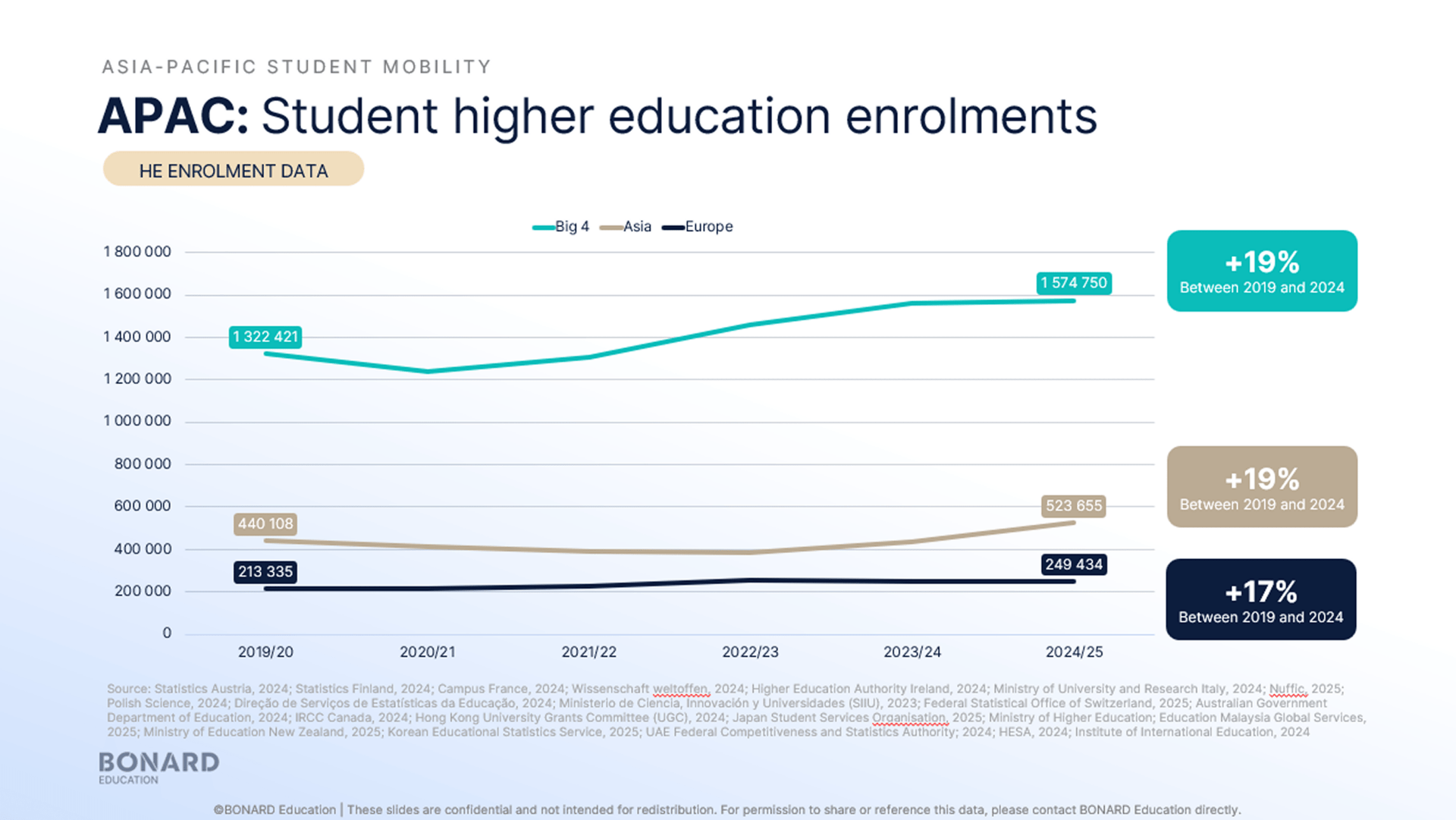
At a macro level, international student enrolments grew materially across study destinations between 2019 and 2024:

Big Four: +19%

Asia: +19%

Europe: +17%
APAC demand is large, persistent, and structurally important, but increasingly contested.
APAC student preferences are becoming pragmatic
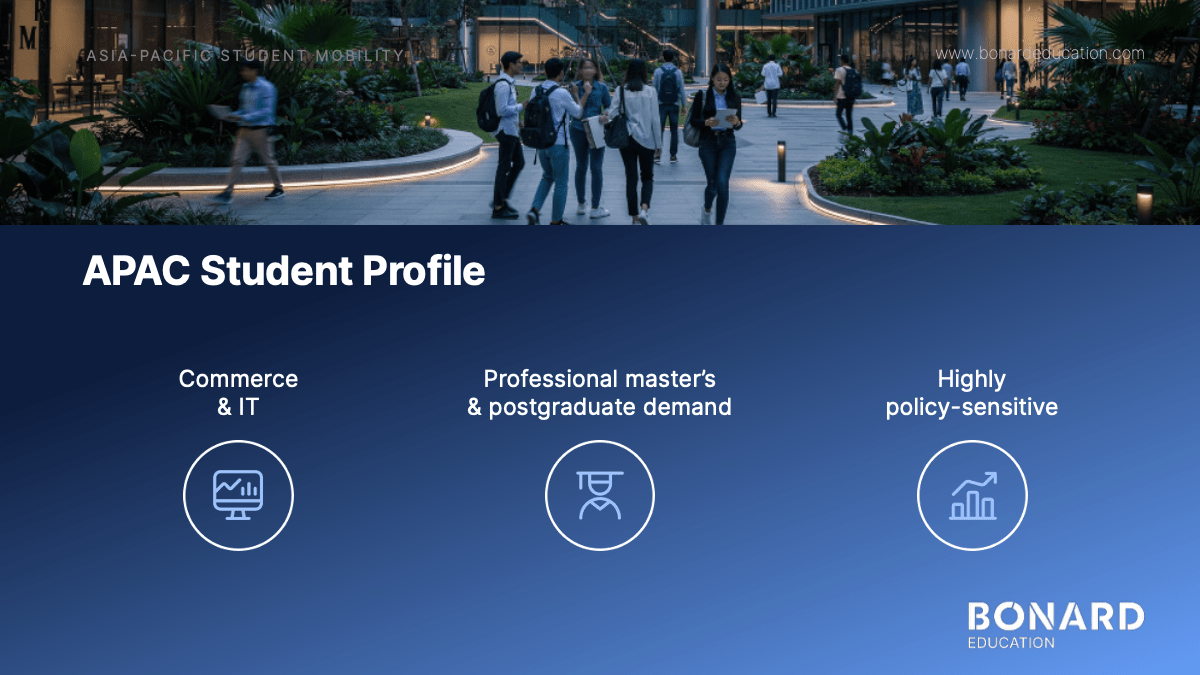
Across major study destinations, APAC students increasingly prioritise practical considerations when choosing where to study. Three factors repeatedly emerge as decisive:
visa certainty
Employability outcomes
admissions and documentation support
While rankings and institutional prestige still matter, they often take a secondary role when policy volatility increases.
Students and families are becoming more risk-aware, evaluating not only where they want to study, but where they can realistically complete the journey from application to visa approval.
This shift changes what drives student recruitment success. Educational institutions increasingly compete on:
predictability rather than prestige alone
tangible outcomes rather than broad brand messaging
conversion capability rather than lead generation volume
WHERE APAC STUDENTS GO NOW:
Redistribution across study destinations
The Big Four used to dominate, now their share is under pressure
Since 2025, roughly 450,000 internationally mobile students have shifted away from traditional study destinations, including a significant share from APAC.
These are not small shifts, they represent a significant market reallocation.
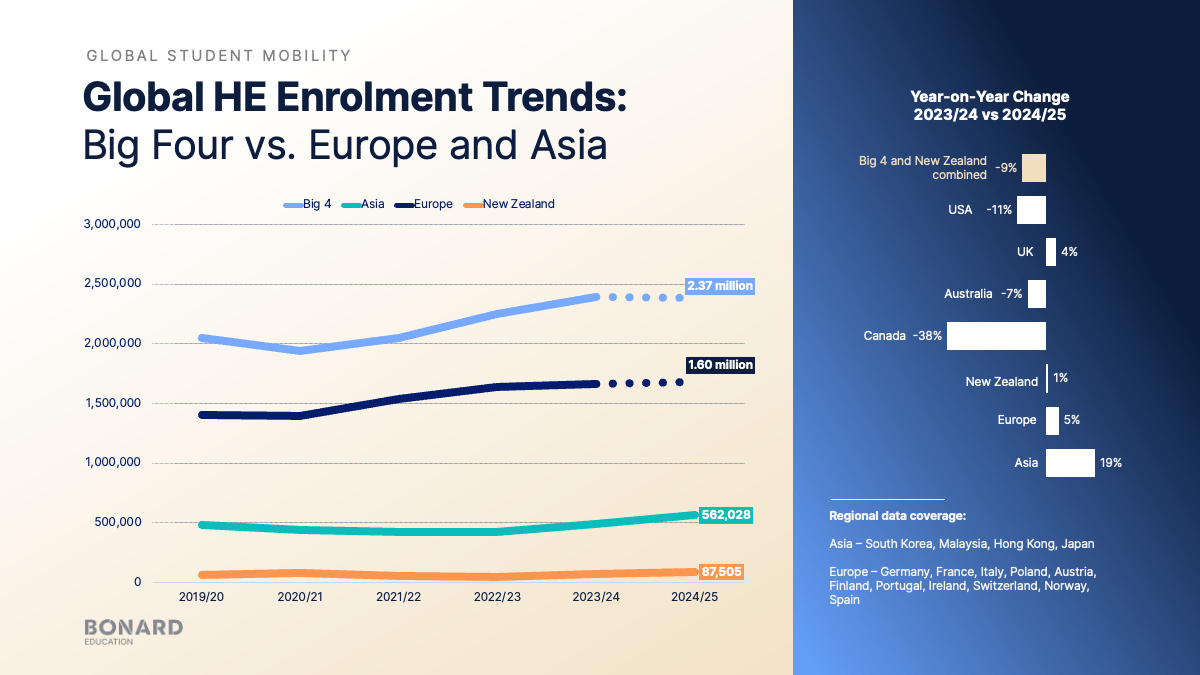
This sits alongside diverging recent enrolment signals (Year-on-Year, 2023/24 vs 2024/25):
Big Four
+ NZ
combined -9%

USA
-11%

Canada
- 38%

Australia
-7%

UK
+4%

NZ
+1%
Europe
+5%
Asia
+19%
These movements represent a meaningful market reallocation. Default destination behaviour is weakening as students increasingly choose locations where the visa process, affordability, and work prospects appear more predictable.
In this environment, “default study destination” behaviour weakens: students reallocate toward study destinations that feel more predictable on visa and cost-to-value.
APAC emerges as an alternative study destination
A major shift is regional retention: APAC study destinations are increasingly keeping students from within the region who previously travelled to Western institutions.
Cities like Singapore, Tokyo, Hong Kong, and Malaysia are emerging as alternatives, but their capacity may not be sufficient to absorb the full growth of redirected demand.
Concrete signals:
Singapore & Malaysia: +50% more students compared to 2019 (positioned as regional hubs with English-medium programmes)
South Korea & Japan: 54,000 more students compared to 2019 (supported by government-funded international student strategies)
UAE: “moderate growth” framed as an emerging transnational education corridor, driven by India
Across these Asian destinations, similar drivers repeatedly appear:
lower total cost compared to Western destinations
geographic proximity to home
government-backed scholarships, sometimes covering nearly full tuition
However, capacity constraints may limit how far this regional expansion can go. Infrastructure, housing, and institutional capacity will likely cap growth in the medium term.
Europe is benefitting as a “stability + pricing” alternative
Europe is increasingly capturing APAC student demand that might previously have defaulted to Canada, Australia, or the US - particularly among students who are more price-sensitive and risk-aware.
In the latest year-on-year comparison (2024/25 vs 2023/24), Europe shows +5% enrolment growth, and forward-looking scenarios point to +3–5% continued growth, supported by relative policy stability and competitive total cost.
Destinations such as Germany, France, Spain, and Italy appear well-positioned within this dynamic because they combine:
relative affordability (fees and/or total cost compared to many traditional destinations),
comparatively stable visa environment,
high perceived safety and quality of life,
strong academic reputation (particularly in engineering, business, and applied sciences),
and, in parts of Europe, a growing supply of English-taught programmes and more established regional mobility pathways.
For universities recruiting from APAC into Europe/UK/Big Four, this means the competitor set now includes:
APAC regional hubs offering lower total cost and closer-to-home options,
English-medium pathways (in-region and in parts of Europe),
and improving post-study and employment ecosystems that make “staying closer” a rational choice, not a compromise.
SO HOW TO ATTRACT AND GRASP APAC MARKET SHARE:
What works now?
1. Build a risk-weighted APAC market portfolio
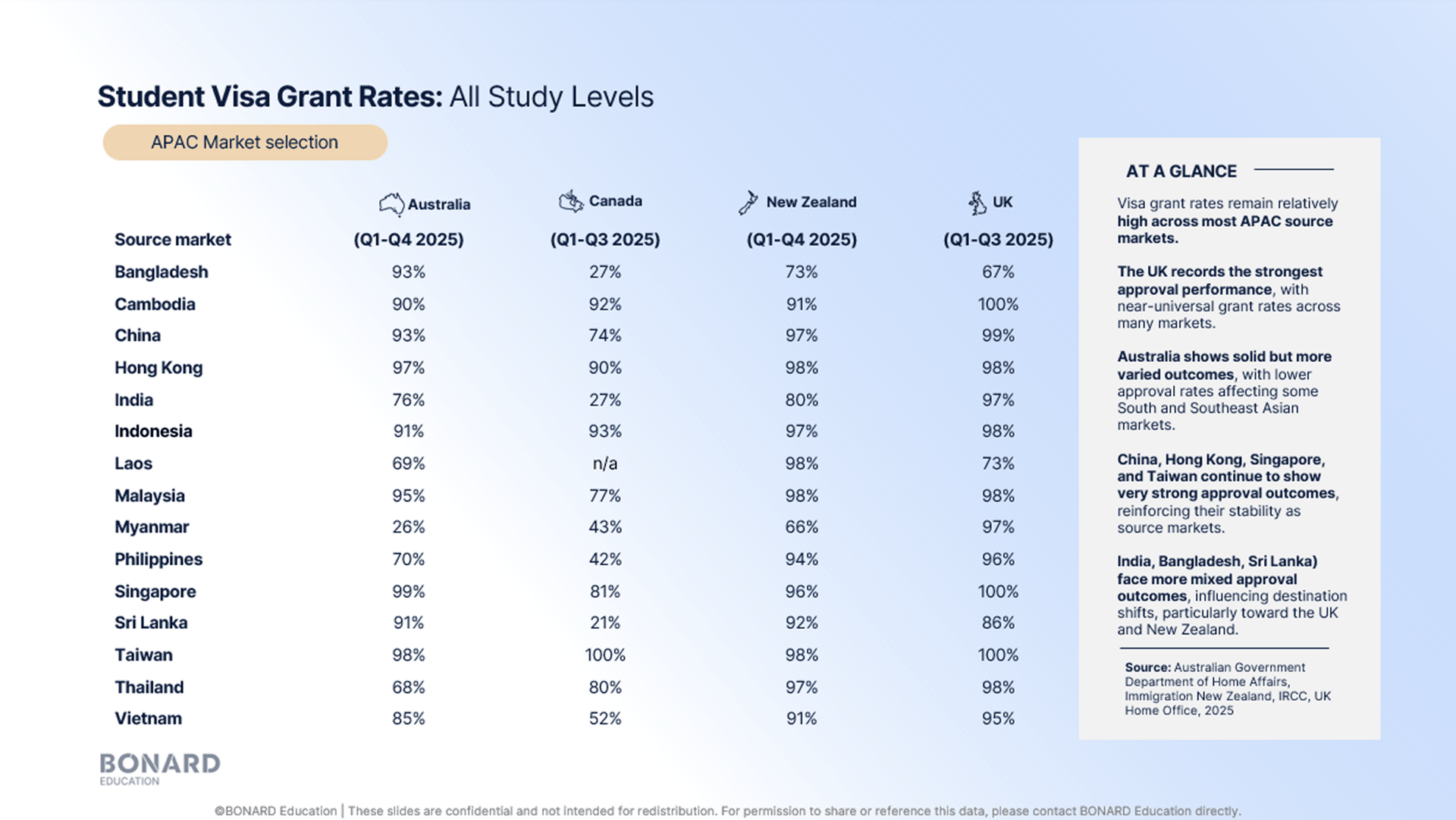
Visa approval rates are a practical indicator of conversion risk and student enrolment predictability. They shape both student confidence and institutional marketing ROI.
Across selected APAC source markets, student visa approval rates vary significantly by destination:
India: Australia 76%, Canada 27%, NZ 80%, UK 97%
Bangladesh: Australia 93%, Canada 27%, NZ 73%, UK 67%
Vietnam: Australia 85%, Canada 52%, NZ 91%, UK 95%
China: Australia 93%, Canada 74%, NZ 97%, UK 99%
Use this to define:
Core APAC source markets (high confidence)
Growth bets (rising demand + manageable risk)
Test source markets (small spend, tight segments, fast learning cycles)
2. Compete on certainty: Make the journey feel predictable
If APAC students prioritise predictability, visa certainty and admissions support, your conversion system must deliver:
faster response times aligned to APAC time zones
clearer “what happens next” steps after enquiry/offer
documentation support and pre-emptive guidance
agent enablement that reduces preventable refusal risk
3. Reframe value around outcomes — with specificity
Career outcomes, post-study work opportunities, and practical learning components are positioned as decisive for APAC students.
That means less generic brand messaging and more proof:
pathway-to-career narratives by programme
placements/internships with clear parameters
alumni outcomes
honest cost-to-value framing
Also, in many APAC countries, international education remains strongly associated with social mobility and prestige, creating sustained aspirational demand.
4. Differentiate against intra-Asia retention (don’t ignore it)
As regional hubs retain more students, institutions outside Asia need sharper differentiation through programme specialisation, niche offerings, flexible delivery, and stronger graduate outcomes.
When Singapore/Malaysia/Japan/Korea grow as study destinations, Western institutions need sharper differentiation:
niche programme advantage,
clearer employability pathways,
more support through admissions and visa complexity,
and credible cost-to-value framing.
Generic “world-class education” messaging will increasingly underperform.
5. Develop pathways and articulation to capture pipeline earlier
Partnerships with local colleges, foundation providers, and private institutions enable earlier capture and smoother transition into degree programmes.
This is especially effective in APAC source markets where students want reduced risk and clearer progression.
Practically, this means:
clearer 1+2 / 2+2 models,
feeder partnerships,
transnational education (TNE) corridors where relevant.
6. Align programme pushes to demand-aligned fields
There are high-demand domains for APAC students:
Domains | Key Fields | Market Driver |
|---|---|---|
Technology & Digital Skills | AI, Cybersecurity, Cloud, Data Science, Computer Science | 32% of APAC employers report IT/data skill shortages. Japan alone faces approximately 220,000 IT professional gap. |
Engineering & Manufacturing | Electrical, Mechanical, Civil, Systems, Aerospace | China represents approximately 29% of global manufacturing output. "China+1" strategy expanding roles in Vietnam and Southeast Asia. |
Healthcare & Life Sciences | Medicine, Nursing, Public Health, Biotech, Pharma. | Growth driven by China, India, Singapore. India is a major global pharmaceutical producer. |
Sustainability & Renewable Energy | Environmental Science, Renewable Energy, Sustainability | 43% of APAC workforce in climate-sensitive sectors. Green jobs forecast to grow regionally. |
Business, Digital & Supply Chain | Business Analytics, Digital Marketing, Supply Chain, MIS | 24% report sales and marketing skill shortages. GCCs in India to add approximately 40,000 jobs by 2026. |

APAC remains the dominant source region for global student mobility. However, the market is fragmenting as students redistribute across a wider range of destinations.
Policy stability, visa certainty, affordability, and career outcomes now shape student mobility patterns as strongly as institutional reputation.
For universities, the opportunity remains enormous, but capturing APAC student demand increasingly requires structured market strategy, operational conversion strength, and differentiated programme positioning, rather than relying on brand gravity alone.
CONTACT FORM
Turn student mobility shifts into your strategic advantage
Whether you are exploring new source markets or adjusting existing ones, our team is here to guide you with actionable, research-backed insights
Since 2007, BONARD Education has supported educational institutions worldwide by tracking international student demand, student visa trends, and market movements.
We know:
Where international students are going
What drives their decisions
How to adapt your student recruitment strategy so that shifting policies do not derail your goals
Submit the form, and learn more about how BONARD Education can support our institution’s student recruitment planning.