


How Ireland can sustain
its international
student boom
Ireland’s international enrolments are rising.
See what the data says, what could derail growth,
and the recruitment strategies Irish institutions
need for 2026–2027.
Ireland’s international education sector is thriving — but maintaining momentum requires strategic precision.
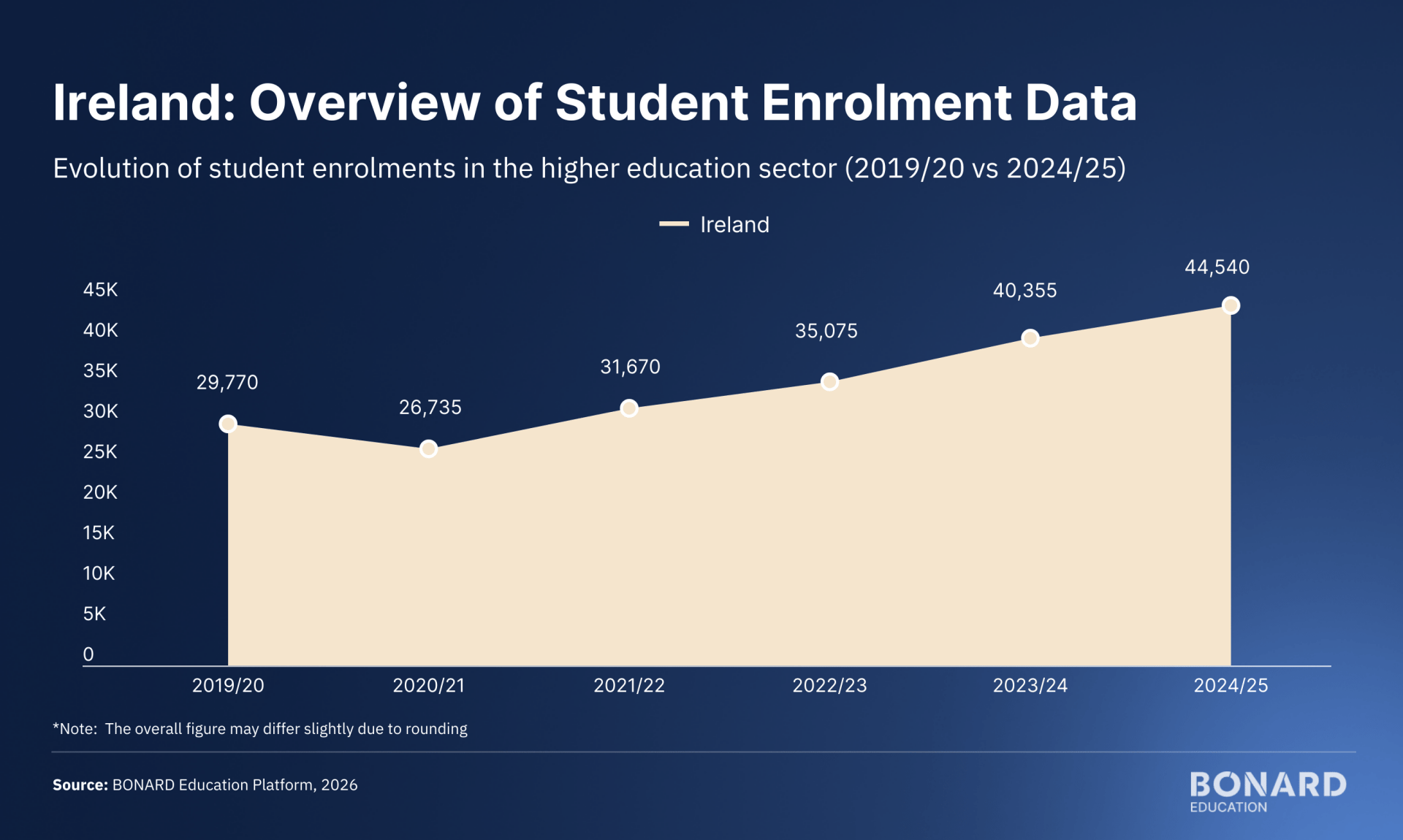
In the academic year 2024/25, publicly funded higher education institutions in Ireland reported 44,540 non-Irish domiciled enrolments, a year-on-year increase of 10.2%. Non-EU students now make up most of that cohort, totalling 32,940 enrolments.
This rise reflects more than post-pandemic recovery, it signals accelerated growth driven by external demand shifts. But as enrolments accelerate, institutions face new questions: How do we avoid over-concentration? How do we strengthen outcomes? And how do we future-proof this growth for 2026–2027?
IF YOU ARE SHORT ON TIME:
Key Takeaways

Ireland recorded 44,540 non-Irish domiciled enrolments in 2024/25 — up 10.2% YoY

Non-EU students account for 32,940 of these, with enrolments split 51.3% undergraduate / 48.7% postgraduate — a strategic advantage

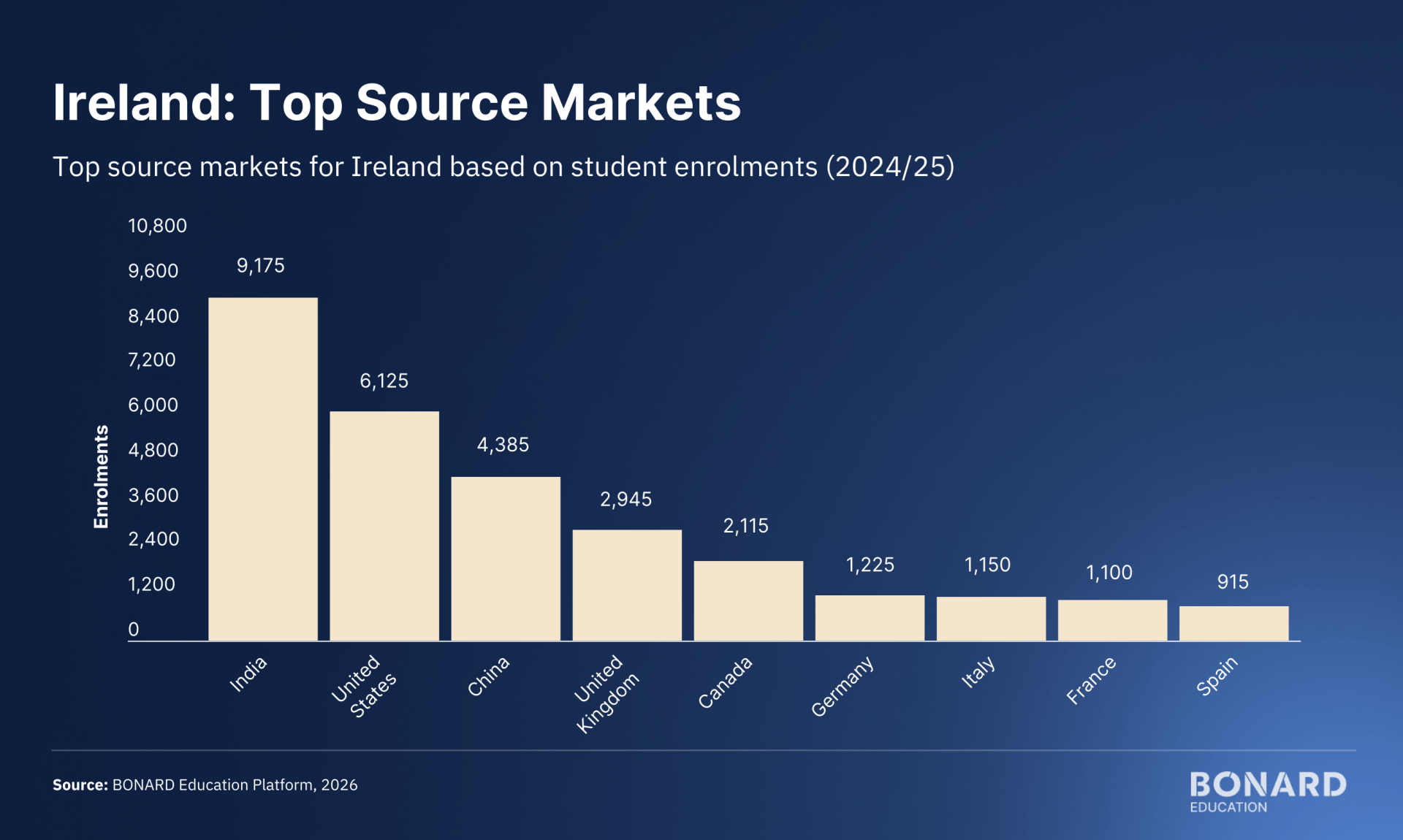
India (20.6%), the US (13.8%), and China (9.9%) remain the top source markets

OECD shows Ireland’s foreign tertiary enrolment share rose from 9.6% (2018) to 12.4% (2023), above the OECD average of 7.4%

Sustainability hinges less on marketing and more on capacity, conversion, and strategic channel management
Ireland’s performance in global context
BONARD Education Platform data indicates that Ireland’s higher education numbers are not just growing, it is recovering faster than many competing study destinations.
After the 2020/21 contraction, university student enrolments have followed a steady upward trajectory, with the strongest gains recorded in the most recent academic cycles. This pattern reflects a system that is effectively converting redirected global demand.
External benchmarks reinforce this positioning.
According to the Higher Education Authority, total enrolments in Ireland’s publicly funded higher education system went up 4.9% in 2024/25 compared to the previous year.
Ireland’s international student share has reached 12.4% (OECD), above the global average. But what matters more is why.
This positioning reflects a combination of factors:
stable student visa processing,
clear post-study work pathways,
and a strong alignment between education and labour market demand.
In a more risk-sensitive environment, these factors increasingly outweigh brand or ranking alone.
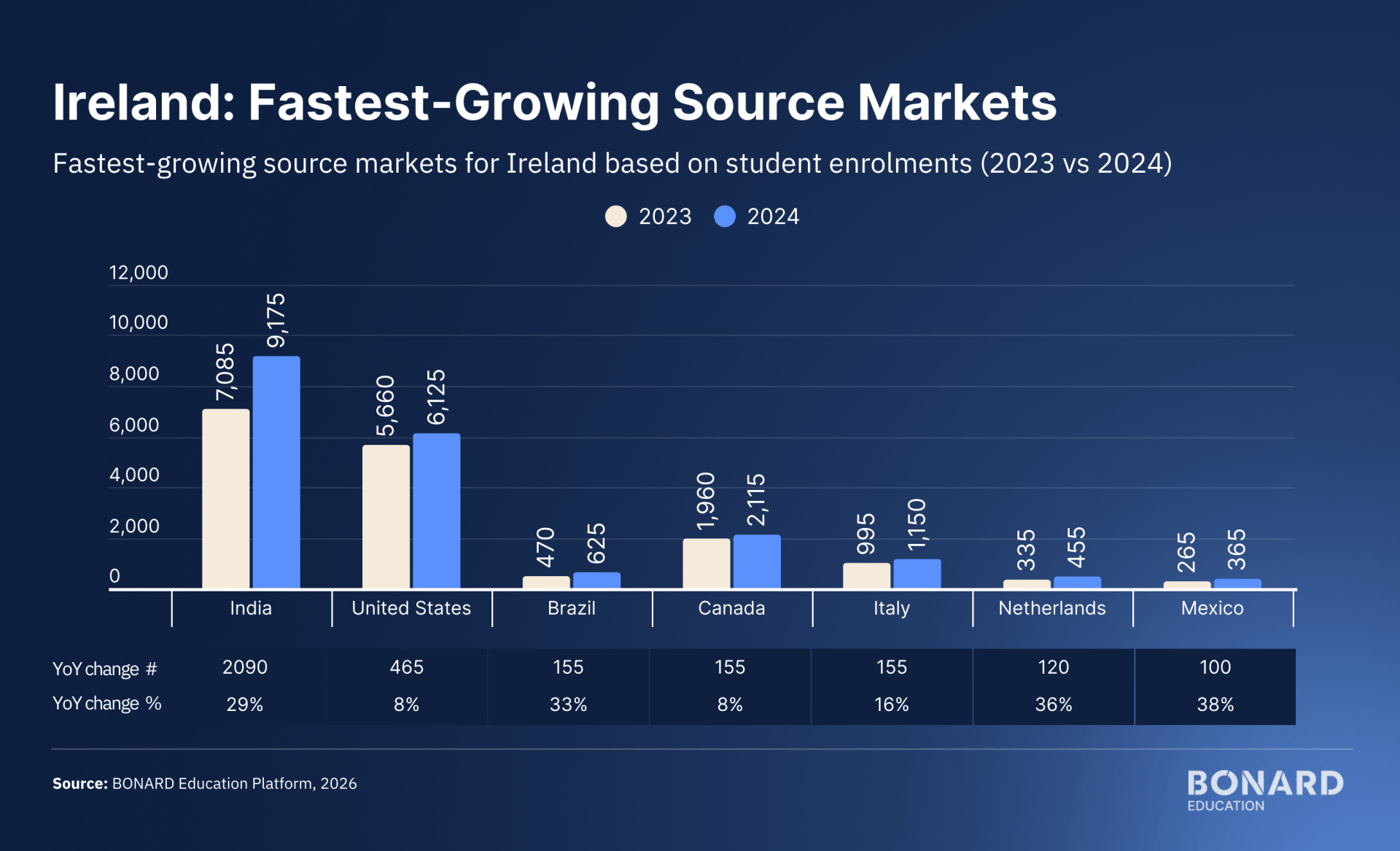
Ireland also shows an unusual source market profile. While most European destinations rely heavily on Asia, Ireland attracts a significant share of students from North America. This diversification reduces exposure to single-region shocks — a growing strategic advantage. (BONARD Education Platform, Eurostat)
What could disrupt Ireland’s momentum
BONARD data highlights that growth systems tend to fail not at peak demand, but at the point where capacity, concentration, and external conditions become misaligned. Four risks stand out.
1. Capacity & student experience constraints
When enrolments outpace onboarding, accommodation, and student support systems, reputational risks rise. While overall system size is expanding, not all institutions or regions have equal capacity to absorb growth.
2. Overconcentration in top source markets
BONARD Education platform data confirms that Ireland’s enrolment base is heavily concentrated in three markets: India, the United States, and China. This is not inherently a risk — unless growth becomes dependent on them.
3. Lagging metrics
Many institutions focus on student enrolments as the primary performance indicator. But early signals typically emerge in student visa data, application-to-offer ratios, and shifts in source market behaviour — often 6–12 months before enrolment impacts become visible.
4. External policy volatility
Ireland’s current growth is partially linked to policy tightening elsewhere. Any easing in major study destinations — particularly Canada or the UK — could reabsorb displaced demand. Institutions should treat current growth as conditional, not guaranteed.
How Irish universities can build a sustainable international student recruitment portfolio
BONARD Education’s student recruitment framework begins with data — and builds toward execution.
A balanced portfolio strategy
According to data from the BONARD Education platform, Ireland’s anchor source markets are India, the United States, and China.
In a fragmented student mobility environment, this portfolio approach is less about growth and more about risk distribution.
Sustaining growth means layering these with diversification and test source markets:
Anchor layer: Strengthen performance in top source markets via clear communications, fast decision timelines, and yield-focused messaging.
Diversification layer: Boost nearby source markets and segments with faster conversion potential. Europe remains a strategic lever here.
Experimentation layer: Test new source markets with defined KPIs: application quality, offer-to-deposit rates, student visa success, and final yield. BONARD data highlights emerging signals from Bangladesh, Brazil, Mexico or Pakistan.
This approach is supported by tools like the BONARD Education Platform, which enables live comparison of source markets, enrolment trends, and visa outcomes across 100+ countries.
Focus on conversion, not volume
As student application volumes increase, the differentiator is no longer demand generation, but institutional ability to process, respond, and convert efficiently.
Ireland’s international student enrolments are nearly evenly split between undergraduate and postgraduate students — a strength if managed well.
Institutions should:
• Define clear intake profiles (conditional offers vs. pre-screening needs).
• Manage admissions capacity for faster decisions and higher yield.
• Align messaging with level-specific drivers (e.g., ROI for PG, parental reassurance for UG).
To operationalise this across your funnel, refer to BONARD Education’s Guide to Design an Efficient International Student Recruitment Strategy, which offers a step-by-step blueprint from market selection to conversion.
Scale through agents, but with governance
In 2026–2027, most Irish institutions will face a common dilemma: diversification requires working with agents, but scale without quality control leads to noise and yield decline
Agent performance varies significantly by source market. High-volume source markets require scale and filtering, while emerging markets demand closer relationship management and guidance.
BONARD Education’s agent management guide emphasizes a differentiated approach — by region and by agent type — with clear standards for student profiles, SLAs, documentation, and communication.
Expansion of your agent network should go hand in hand with governance. Otherwise, the “boom” will consume itself.
Promote Ireland’s work-and-stay advantage
In current student decision-making, work rights are not a secondary benefit — they are a primary filter in study destination selection. Student decision-making increasingly hinges on affordability and post-graduation pathways.
Stamp 2: Allows non-EEA students to work up to 20 hours/week during term and 40 hours/week during holidays.
Stamp 1G: Grants eligible graduates 12 months of post-study work permission (longer for master’s-level graduates).
This is not a sidebar FAQ — it’s a primary student recruitment message. For many students, the combination of access + cost + outcomes + work rights define study destination choice.
Don’t overlook ELT: a powerful student recruitment engine
In a more competitive and fragmented landscape, ELT pathways provide a lower-risk entry point for students and a controllable pipeline for institutions.
Ireland’s English Language Education (ELT) sector is often underestimated as a feeder for higher education.
BONARD Education’s Annual Report on ELT in Ireland 2024, developed in partnership with English Education Ireland, shows that in 2024, Ireland welcomed 128,761 international ELT students — generating €792 million in direct economic impact.
This is not just economic value. It’s a pipeline — for pathways, partnerships, and progression strategies that can feed directly into your HE recruitment portfolio.
2026–2027 action plan for Irish institutions
Not all actions carry equal weight. Based on current data signals, institutions should prioritise the following:
1. Measure concentration risk | What proportion of your international intake comes from just 3 source markets? |
2. Define your funnel metrics | Enquiries and applications don’t equal student enrolments. Institutions need to track quality → offer → acceptance → deposit → visa → enrolment. Without that, you’re flying blind. |
3. Stabilise and experiment | “Defend and grow” in your anchor source markets. Meanwhile, test 2–3 new source markets annually with clear KPIs and conversion targets. Use the BONARD Education Platform to benchmark and adjust. |
4. Formalise agent governance | As you expand your network, create onboarding frameworks, reporting standards, and region-sensitive expectations. BONARD Education’s agent insights show that collaboration thrives when tailored to local norms. |
5. Activate ELT partnerships | If you’re in HE, partner with high-performing language schools to build clear progression routes. ELT is a massive ecosystem — and a direct line to more sustainable international enrolments. |

Ireland’s current growth trajectory reflects a broader shift in global student mobility — from preference-driven to constraint-driven decision-making. The institutions that will sustain this growth are not those that recruit more, but those that align capacity, conversion, and market selection with how students now choose. In this environment, international student recruitment becomes less about expansion — and more about precision.
FAQ
44,540 non-Irish domiciled students were enrolled in 2024/25, up 10.2% YoY (HEA 2025).
India (20.6%), the United States (13.8%), and China (9.9%) lead the source market portfolio (HEA 2025).
Eurostat reports that 15.8% of foreign tertiary students in Ireland come from North America — the highest in the EU.
Yes. Stamp 2 allows up to 20 hours/week during term and 40 hours/week during holidays.
BONARD reports that Ireland’s ELT sector welcomed over 128,000 international students in 2024 — a major channel for future HE pathways and diversification.
CONTACT FORM
Turn student mobility shifts into your strategic advantage
Whether you are exploring new source markets or adjusting existing ones, our team is here to guide you with actionable, research-backed insights
Since 2007, BONARD Education has supported educational institutions worldwide by tracking international student demand, student visa trends, and market movements.
We know:
Where international students are going
What drives their decisions
How to adapt your student recruitment strategy so that shifting policies do not derail your goals
Submit the form, and learn more about how BONARD Education can support our institution’s student recruitment planning.