


USA: 14% decline in students at ELT providers in 2025
English language providers in the USA experienced a 14 percent decrease in international students in 2025, according to the latest annual report by EnglishUSA, with declines across all provider types and several major source markets as providers cite political instability and student visa denials.
Key points
227 English language providers participated in the 2025 research by EnglishUSA.
Political instability, visa issues, declining enrolments affecting budgets, visa delays and safety concerns were cited by providers as the biggest challenges to enrolment.
20% of students were juniors in 2025 - a higher ratio than previous years, partly explained by a higher proportion of private ELT providers in the research.
Numbers at a glance
64,654
students enrolled at 227 providers in 2025
-14.3%
decrease in students compared with 2024
US$1.4bn
estimate of direct spend value of the sector
10.4 weeks
average stay in 2025
The Annual Report on English Language Programs in the USA 2025 by EnglishUSA , in partnership with research partner Bonard, is based in the responses of 227 providers – 70 per cent of which were EnglishUSA members.
Headline data: The report shows that there were 64,654 international students enrolled at those institutions in 2025.
They delivered a total of 673,220 student weeks, an average stay of 10.4 weeks – down from 12.8 weeks in the previous year, although this is partly attributable to a higher share of private providers in the research, the authors said.
On a like-for-like comparison of providers that completed the survey in both years, there was a 14.3 decrease in student numbers and a 19.6 decline in student weeks in 2025, compared with the previous year.
The source region of students in 2025. Source - EnglishUSA/Bonard.
Direct economic spending by international students at schools participating in the survey stood at $870 million, and the authors estimated a direct contribution of $1.4 billion across all English language providers in the USA. The average spend was $12,480 per student.
Provider type: The number of English language programs (ELPs) participating in the research declined from 349 in 2024 to 227 in 2025, and Bonard noted that in it mapping of the sector a number of providers were found to have permanently closed or were no longer offer English language programmes for international students.
There were declines across all types of provider, with student numbers down by 10 per cent at private providers, 19 per cent at university-government ELPs, 16 per cent at college-governed programs, and 12 per cent at community college-governed ELPs.
In the 2025 research, private (independent or muti-site) providers accounted for 65 per cent all student enrolments and 51 per cent of student weeks.
Source markets: For the first time in the EnglishUSA market report, France was the top source market with 7,539 students and increased by nine per cent for providers that did the survey in both of the last two years.
France was followed by Brazil with 7,203 students (-13 per cent year-on-year); China with 6,573 (-21); Japan with 5,461 students (-21); and Italy, which increased by 15 per cent to 5,400.
Japan was the top source market in the previous year’s research, but as previously reported Japanese agency association JAOS indicated a large decline in individual clients last year. Nonetheless, Japan remained the top source market for university- and college-governed providers in the USA.
In year-on-year comparisons, Poland (+46 per cent), Spain (+23) and Portugal (+87) were strongly increasing markets, highlighting the importance of European source countries for the USA last year.
Source - ST magazine
Europe was the largest source region, accounting for 34 per cent of students, followed by Asia (32) and South America (24). The Middle East (three) and Africa (two) have declined in market share, hampered by high visa refusal rates, lengthy visa processing and travel restrictions imposed last year.
Recruitment channels: Overall, 58 per cent of students in 2025 booked directly, while 25 per cent came via an agency, seven per cent arrived through institutional agreements, five per cent were on government scholarships, one per cent came through aggregators, and the remained reserved through other methods.
It should be noted that only 74 per cent of students were residing outside of the USA at the time of their enrolment, indicating that the USA has a stream of domestic recruitment that is higher than is typical in competitor destinations.
Nonetheless, in score-based ranking of advertising channels, agency recommendations rated second for participating schools, behind word of mouth and ahead of social media, print advertising, email campaigns, education events and student fairs.
Student profile: Adult students accounted for 80 per cent of students, down from 90 per cent in the previous year. This was attributed to a higher proportion of private ELT providers in the research, but also greater resilience of junior demand while adult numbers declined, the authors said.
Junior students were heavily concentrated in the private sector, where they accounted for around a quarter of all enrolments, compared with around 12 per cent at university-governed providers.
Visa type: The F-1 visa was the most common route, accounting for 40 per cent of students, while the ESTA increased share to 31 per cent – reflecting a higher proportion of private providers and increased demand from European markets that can take advantage of the visa-waiver program.
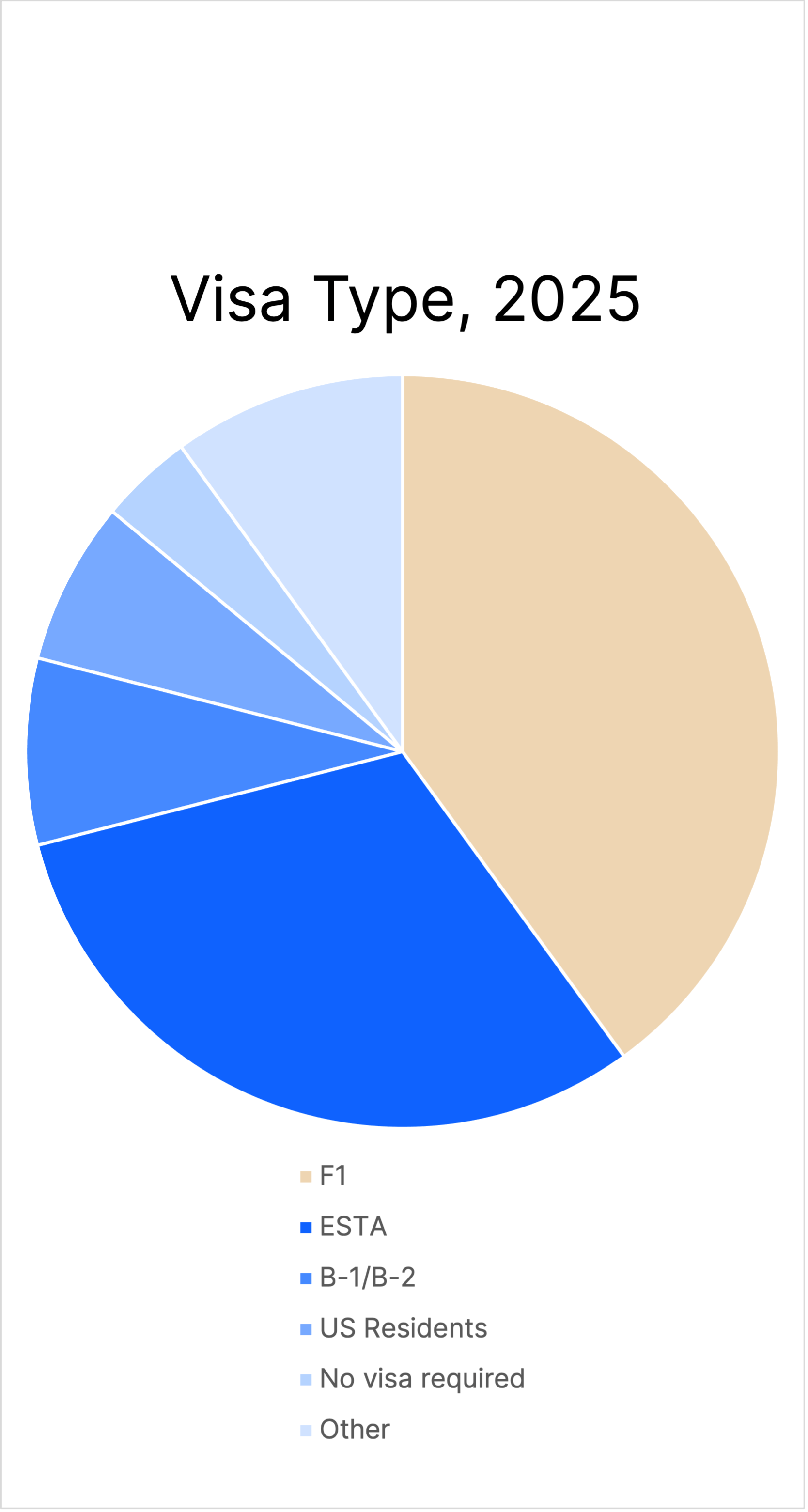
This was followed by B-1/B-2 visitor visas (eight per cent), US citizens and permanent residents (seven), and individuals who did not require a visa (four).
Host states: New York was the largest host state with 18,930 students (-three per cent year-on-year), followed by California with 11,115 (-16) and Florida on 8,425 students (-20). Utah was the only top ten host state to register an increase in student numbers in 2025.
New York was the leading host state for both adult and junior students. In the former category, it was followed by California, Florida, Hawaii and Massachusetts, while for juniors Florida, California, Massachusetts and Maryland made up the top five.
Course type: General/Intensive English programs were comfortably the most popular course type, chosen by 54 per cent of students, and were top for every provider profile, followed by short-term summer/winter courses (18) and English for Academic Purposes (15) and pathways (seven).
France was the top source for General/Intensive course with 14 per cent share, followed by Brazil (10) and Japan (six). For summer/winter courses, Italy commanded 18 per cent share, followed by France (15) and Japan (nine).
For English for Academic Purposes there was a different student profile, led by Kuwait (13), Brazil (12) and China (11), while the latter dominated the pathway segment on 38 per cent, followed by UAE and Brazil (both seven).
 Source - EnglishUSA/Bonard
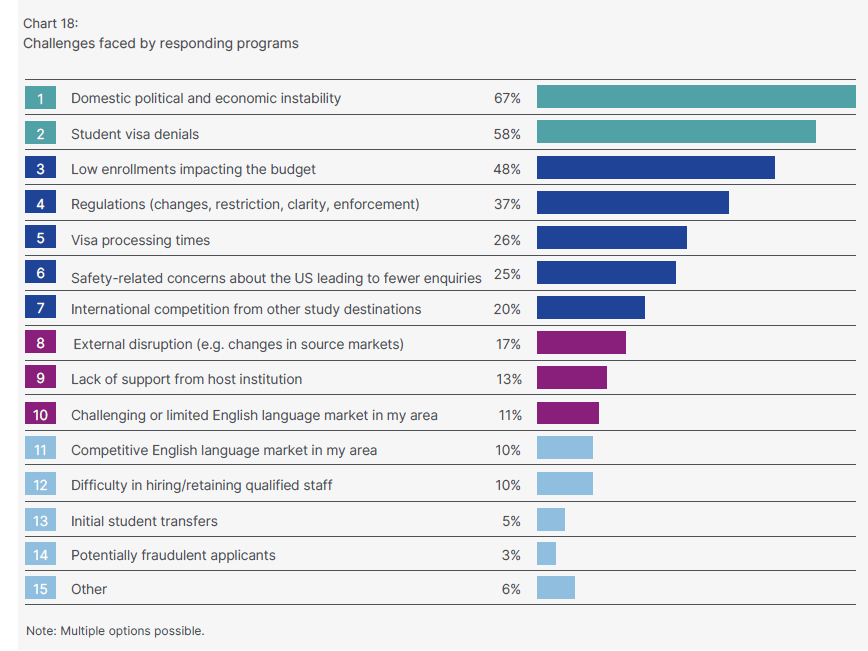
Challenges to growth: The authors said that changes to US immigration policy and increased visa scrutiny affected recruitment, but a global economic slowdown, inflationary pressures and currency fluctuations also impacted on student demand, with many other English language destinations experiencing a decrease in 2025.
Schools rated domestic political and economic instability as the biggest challenge faced in 2025 (67 per cent), followed by student visa denials on 58 per cent.
A total of 124 providers reported visa refusals, with the highest number of reported refusals for Russia (649), followed by Türkiye (441), Nepal (400) and Brazil (337). Markets such as Ukraine, Indonesia and Mauritania were in the top ten by refusals for the first time, the authors said.
Other factors cited as challenges included low enrolments impacting the budget (48), regulations (changes, restrictions, enforcement) on 37 per cent, visa processing times (26) and safety-related concerns about the US (25).
Cheryl Delk-Le Good , Executive Director of EnglishUSA, said in the foreword, “The findings in this report remind us that our sector is operating within a highly competitive global marketplace while also responding to changing U.S. policies, evolving student mobility patterns, and increased uncertainty affecting international education.
“Although these realities present significant challenges, they also underscore the importance of working together as a community - sharing information, learning from one another, and speaking with a unified voice about the value of English language education in the United States.”
Click here to access the report on 2025 business trends by EnglishUSA, which represents more than 200 accredited English language providers in the USA.
Top image - HClarke/Shutterstock.com
by Matthew Knott, News Editor
CONTACT FORM
Find out how we can cater to your specific needs
We look forward to assisting you further and explaining how our services can benefit you.