


Industry Update I January 2026
Stay ahead in the international education sector with the latest news, events, and insights.
Thank you for your trust in 2025.
As we move into 2026, we remain committed to providing timely, data-driven insights to support informed international student recruitment decisions in an increasingly complex environment.
Global demand for international education continues to grow at around 3% per year. However, it is now policy, rather than student preference, that plays the decisive role in where students enrol.
2025 was marked by a redistribution. An estimated 165,000 students redirected their study plans away from the Big Four in response to tighter student visa regimes, processing backlogs, and rising cost pressures.
The result is a clear structural shift: traditional study destinations should not rely on their automatic appeal, international student mobility is becoming more fragmented and regionalised, and factors such as visa predictability, affordability, safety, and post-study work opportunities are increasingly decisive.
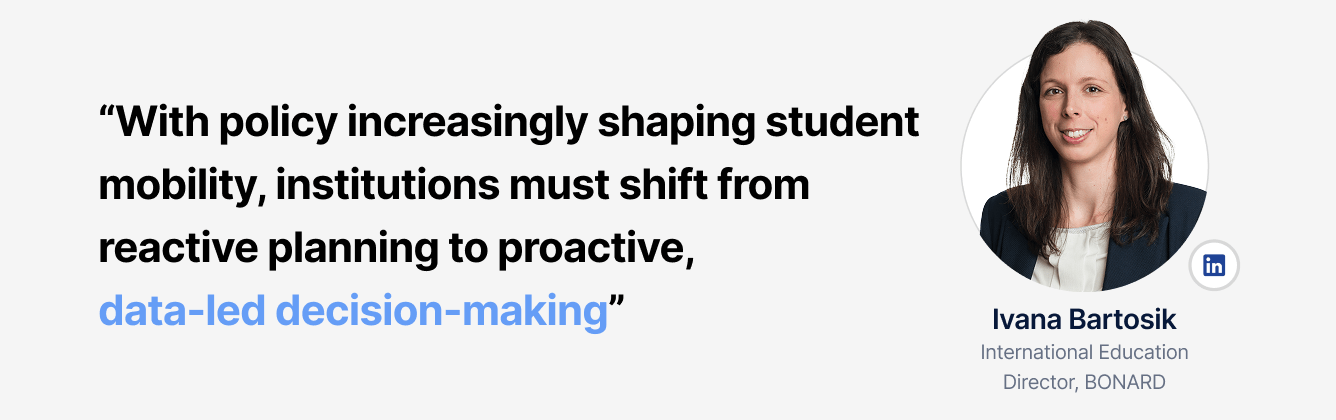
What we expect in 2026
Based on current data, we anticipate:
Greater fragmentation of student pathways
Continued rise of regional education hubs (Asia, Europe, Middle East)
Stronger growth in TNE and hybrid delivery models
+3–5% growth in international students choosing Europe
+10–15% growth in Asia, driven by affordability and policy clarity
Students behaving more like risk managers than aspirational shoppers
To remain competitive in this environment, we advise education providers to:
Diversify international student portfolios
Avoid over-reliance on any single study destination or source market
Regularly monitor:
Student visa approval rates
Cost–value balance
Work rights and employability
Trusted agent networks
In 2026, the institutions that succeed will be those that plan proactively for policy volatility, not those waiting for a return to post-pandemic norms.
We explore these insights in more detail in the Q1 2026 edition of BONARD Education’s Global Student Flows Briefing. You can access the presentation and recording below.

Source markets to watch in 2026
Below are the fastest-growing source markets from Q1 2025, based on student visa issuances. Are these countries on your 2025/26 target list?
 Canada
France
USA
Japan
South Korea
 UK
UK
Nigeria
Nepal
Bangladesh
Türkiye
 USA
USA
Brazil
Nepal
Vietnam
Bangladesh
 Australia
Nepal
Bangladesh
Indonesia
Kenya
 New Zealand
Philippines
Nepal
Vietnam
Fiji
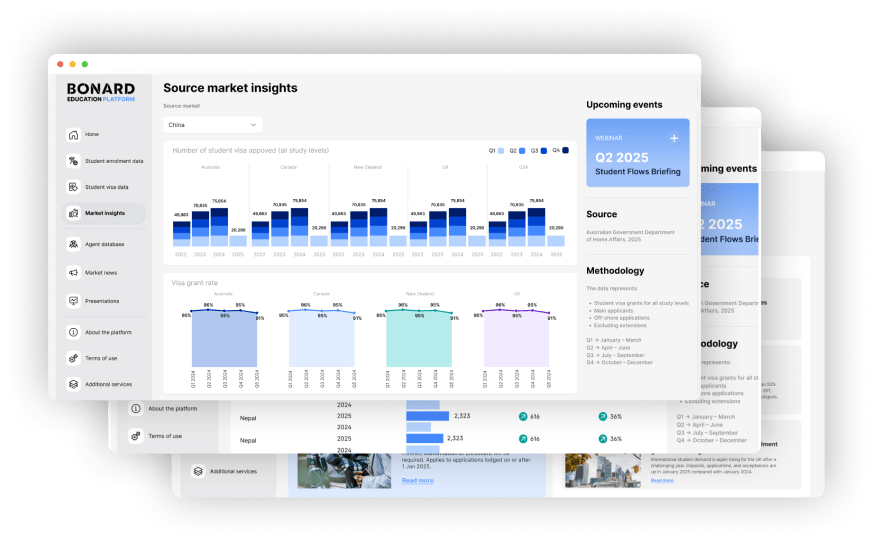
The new US visa restrictions are accelerating student flow re-routing

Recent US visa announcements have triggered a significant re-routing of international student demand.
Rather than reducing overall interest in the US as a study destination, current developments are reshaping who applies, when, and from where.
What is changing
20 nationalities are now subject to a full suspension of student visa issuance, with partial suspensions applied to an additional 75 countries
new restrictions extend to F, M and J visa categories, affecting both first-time applicants and, in some cases, extensions
processing times remain unpredictable, increasing uncertainty for institutions and applicants alike
Early impact on US higher education
2025 is expected to see a 30% decline in new higher education intakes, driven largely by the suspension of visa interviews in June 2025 and the slow recovery of Indian applications
2026 is unlikely to deliver the stabilisation many had hoped for, and any meaningful recovery now appears to be a mid- to long-term prospect rather than an imminent turnaround
What this means for US institutions
This is not a collapse in global demand, but an acceleration of student flow re-routing. Institutions will need to move away from broad, one-size-fits-all student recruitment approaches and adopt source market-specific strategies, aligned with visa accessibility, application timing, and post-study pathways.
As policy volatility increases, continuous monitoring of visa trends and proactive adjustment of student recruitment priorities will be essential to managing enrolment risk.
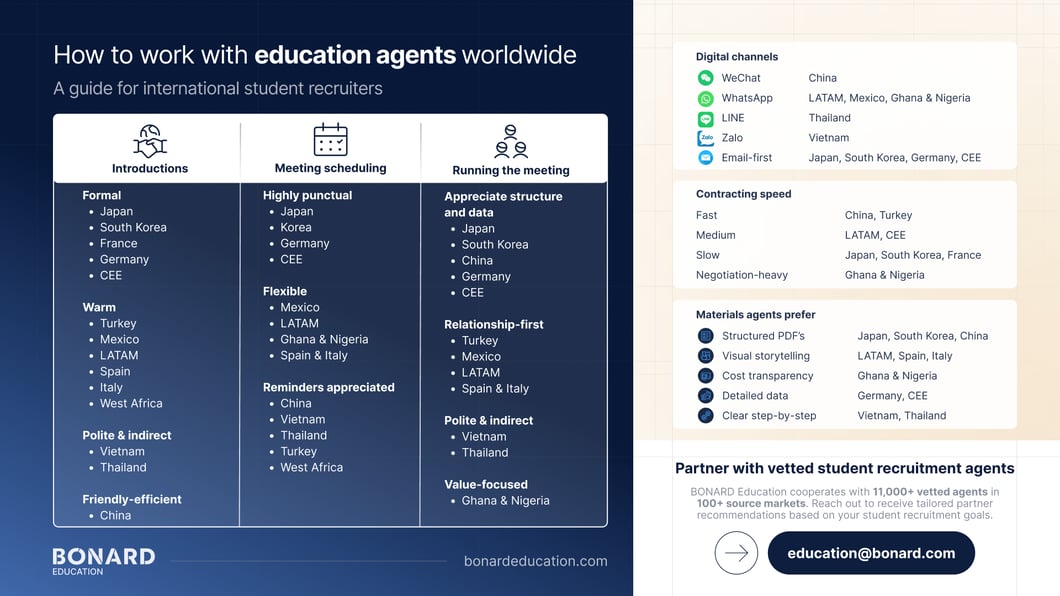
How to work effectively with education agents worldwide
Drawing on BONARD Education’s 20+ years of global fieldwork - and cooperation with 11,000+ agents across 100+ source markets - we developed a guide, which outlines several tips on how to engage with agents in the world’s major regions.
Meet BONARD Education at
Meet our team and join our sessions at the upcoming conferences

Languages Canada Annual Conference
11-14 March 2026,
Calgary, Canada
News You Should Not Miss
Latest headlines from the BONARD Market Monitor
Stay informed via our Market Monitor and receive the latest industry news in your mailbox daily
SUBSCRIBE TO INDUSTRY UPDATE
Stay close to the international education sector
Subscribe to Industry Update for monthly insights on international student mobility, student visa trends, source market developments, and selected BONARD Education analysis.
Designed for international education leaders, student recruitment teams, education providers, associations, and sector stakeholders navigating global student recruitment trends.