

Key Takeaways from BONARD's Q1 2026 Global Student Flows Briefing

In 2026, international student mobility is not declining; it is reorganising. Educational institutions across the globe must diversify their international student recruitment and use accurate data to stay ahead

January 13, 2026 By Sarah Verkinova

Global demand for international education continues to grow (~3% annually), but student mobility is being reshaped by policy, not preference.

2025 was not a collapse. It was a redistribution shock. Around 165,000 students changed study destinations due to student visa policy tightening, processing limits, and cost pressures.

The result: fewer “default” study destinations, more fragmented and regionalised international student mobility, and rising importance of visa certainty, affordability, safety, and post-study work rights.

At the Q1 2026 edition of BONARD Education’s Global Student Flows Briefing, our research team revealed the latest student visa data in the 'Big 4' + New Zealand, powered by the BONARD Education Platform.

Study destination performance: what actually happened in 2025

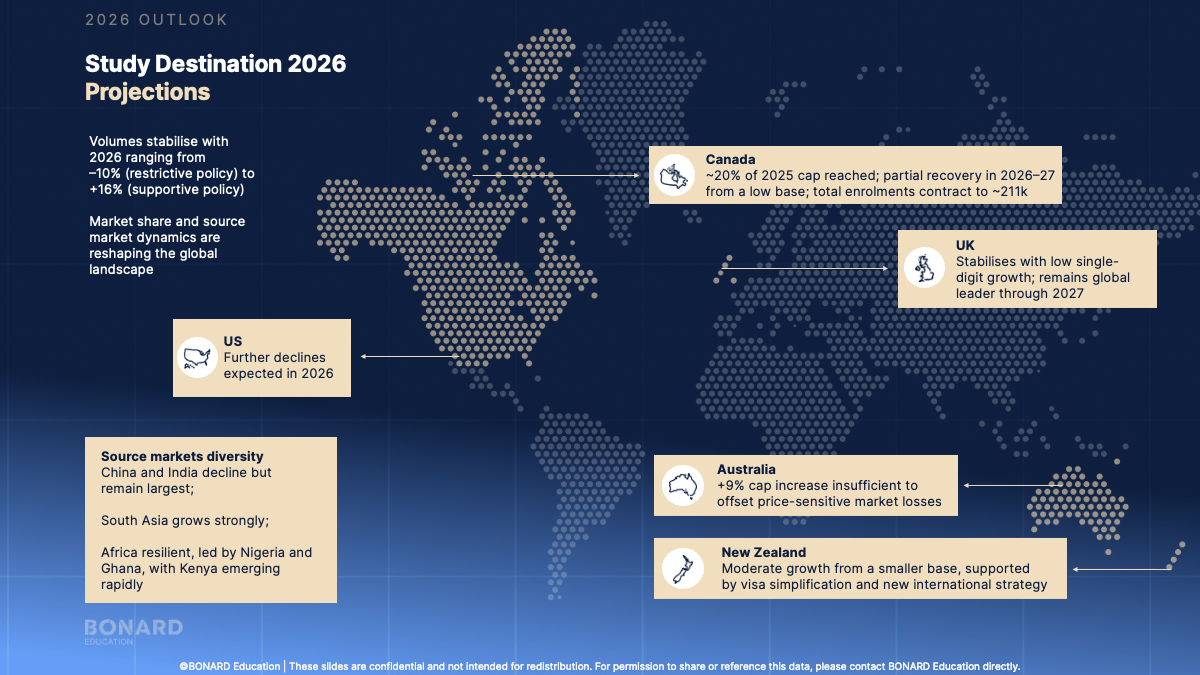
UK: the anchor among the Big Four

  • Only Big Four destination to grow in 2025

  • Applications +7% YoY

  • Visa grants projected at ~422,000 (+6%)

  • Strong growth at Master’s level (+30%), driven by India, Nigeria, Nepal, Bangladesh

  • Bachelor’s also up (+12%) with more diversified demand

  • Risk: tighter refusal-rate thresholds (≤5%) limit access from Pakistan & Bangladesh despite demand

Outlook: Broad stability through 2026–27 (~365k new entrants/year)

Australia map icon

Australia: stabilising, but structurally smaller

  • Demand decline slowed in late 2025 (possible “floor”), but recovery is weak

  • Visa grants projected ~198,000 in 2025 (-12% YoY)

  • Higher education still dominant (74% of grants), but under pressure

  • English language sector hit hard (-35%)

  • Declines driven mainly by China

  • Growth from Nepal & Bangladesh, but not enough to offset losses

Outlook: Further contraction likely (-7–10%), settling into a smaller, more selective market

Australia map icon

Canada: sharp contraction, slow rebuild

  • Most severely impacted study destination

  • Applications down ~51% YoY

  • Study permits down ~60% YoY

  • College sector collapse (-83%)

  • Approval rates fell below 60%

  • India accounted for ~half of total decline

  • Mixed policy signals: tighter caps vs talent-attraction initiatives

Outlook: Gradual recovery only

~50k grants in 2026 → ~56k in 2027 (still far below pre-2024 levels)

Australia map icon

New Zealand: managed stability

  • Policy deliberately supportive

  • Clear growth ambition: 83k students (2024) → 105k by 2027

  • Expanded student work rights (20 → 25 hrs/week)

  • New short post-study work option (6 months)

  • Student visa grants projected ~80,600 in 2025 (-2% YoY)

  • High visa approval rates overall (e.g. Philippines ~94%)

  • Nepal growing fast but with lower approval certainty (~77%)

Outlook: Gradual, controlled growth—not a rebound spike

Australia map icon

United States: access shock, not demand collapse

  • 2025 defined by processing disruption, not lack of interest

  • Student visa interview pause (June–July) hit peak intake window

  • Student visa grants estimated -33% YoY (~261k)

  • Fall 2025 intake likely >50% down

  • Declines strongest from India, China, South Korea

  • Growth from Brazil, Nepal, Vietnam, Bangladesh, but too small to compensate

Outlook: 2026 = inflection point

Baseline ~233k visas; downside risk if India tightens further

Source market dynamics: what’s really shifting

India

  • Still the most important source market globally

  • Strong declines in Canada

  • Modest drops in Australia & NZ

  • Strong growth in the UK

China

  • Structural decline in outbound student mobility

  • Shift toward closer-to-home study destinations in Asia

  • Still resilient for the UK, Australia, NZ

Nepal & Bangladesh

  • Fastest-growing source markets, highly price- and access-sensitive

  • Rapid responders to policy changes

Japan & South Korea

  • Continued long-term softening

US as a source market

  • Surprisingly stable flows to UK & Canada

Q1 2026 Source Market Index

"International student mobility is not disappearing.

It is rebalancing toward certainty and proximity"

Sarah Verkinova, Head of International Education, BONARD Education

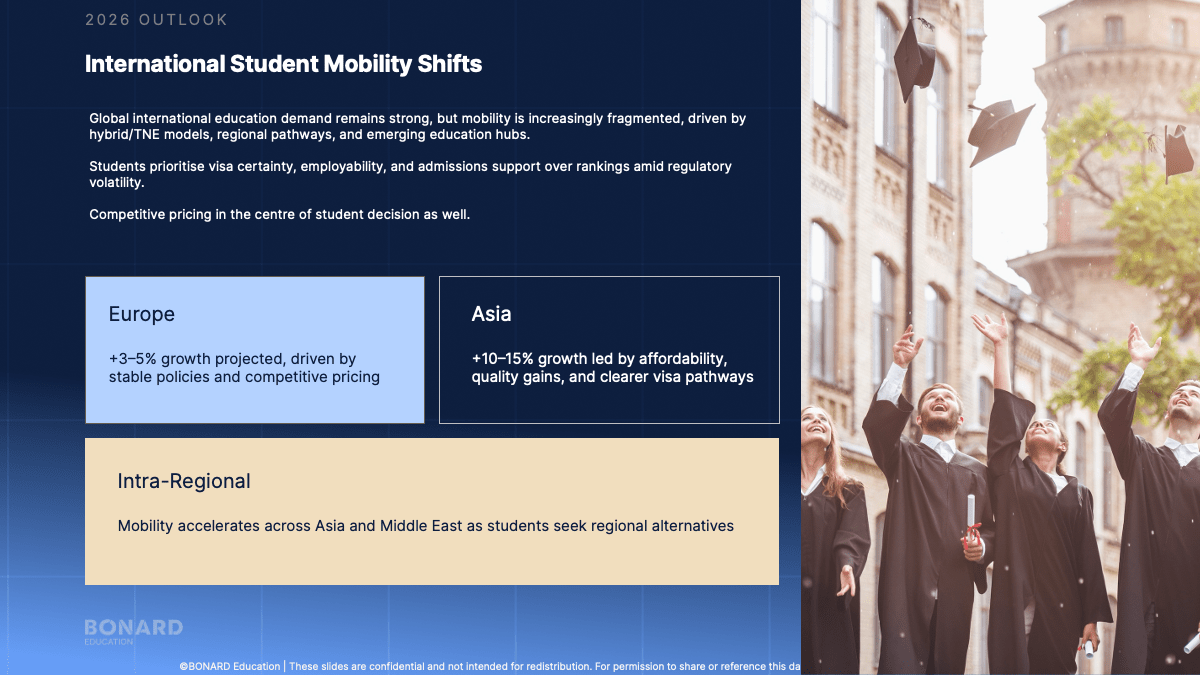
Structural trends shaping 2026+

  • Fragmentation of student pathways

  • Rise of regional hubs (Asia, Europe, Middle East)

  • Growth in TNE and hybrid models

  • Europe projected +3–5% annually

  • Asia projected +10–15%, driven by affordability and clarity

  • Students behaving more like risk managers than aspirational shoppers
Q1 2026 Projections

Strategic implications for institutions

This briefing quietly delivers a sharp warning:

  • Source market diversification is no longer optional

  • Over-reliance on a single study destination or source market is now a structural risk

  • Student recruitment strategies must prioritise:

    • Student visa success rates

    • Cost-value balance

    • Student work rights & employability

    • Trusted agent networks

The winners in 2026 will be those who plan for policy volatility, not “post-pandemic recovery”
Q1 2026 Projections 2

The BONARD Education Platform helps institutions benchmark student visa performance, map enrolment data, evaluate market potential, and make informed international student recruitment decisions.

Q1 2026 GLOBAL STUDENT FLOWS BRIEFING

Webinar Recording

Missed the live session? The full recording is available for subscribers or upon request (via the form below).

CONTACT FORM

Recording and presentation - request form

Access the latest international student mobility trends by submitting this form

Do you want to learn more about the presented data? Explore our data platform - the most advanced source for international education market intelligence.

Access previous Global Student Flows Briefings