


Key takeaways from BONARD's Global ELT Annual Report 2026
International student mobility is not declining; it is reorganising. The latest student visa, enrolment and source market data points to a more fragmented and controlled phase of global student mobility.
Down 23%: the number that explains what's really happening in global ELT
The global English language teaching (ELT) sector declined for a second consecutive year in 2025. But the headline decline masks the more important story: this is a change in the shape of the market, not a temporary dip. For providers planning 2026 and 2027, where demand is moving matters more than the fact that it is falling.
Our Global ELT Annual Report 2026 tracks student mobility across the eight major ELT study destinations — Australia, Canada, Ireland, Malta, New Zealand, South Africa, the UK and the USA. Below are the signals we observe, and what they mean for institutions.
What the data shows
Across the eight major destinations, 901,877 students generated 5,820,300 student weeks in 2025. Compared with 2024, student numbers fell by 10% — but student weeks fell more than twice as fast, by 23%. These follow declines of 7% and 12% in 2024.
That gap between the two measures is the central finding. Student weeks generate revenue, so a steeper fall there puts real pressure on provider margins. The driver is a change in who is travelling and for how long: average length of stay fell from 8.3 weeks in 2022 to 6.5 weeks in 2025, the lowest in a decade. Fewer adult students — who typically enrol in longer programmes and carry the volume — are travelling, while shorter courses and the junior segment gain relative weight.
We read this as a structural shift rather than a correction, shaped by three forces:
Affordability
Rising tuition, travel and living costs in destinations, combined with weaker currencies and economic pressure in source markets, have pushed cost far higher up students' decision-making.
Reduced adult mobility
Government interventions — visa policy, caps, higher financial requirements — have hit longer-duration adult demand hardest.
Widening competition
In-country English provision is expanding, while alternative destinations such as the Philippines, Malaysia and the UAE compete on cost and proximity.
Performance varies sharply by destination
The market-wide decline is not evenly distributed — and that variation is where the practical opportunity sits.
🇦🇺 Australia
-35%
Steepest fall in student weeks. A decisive factor was the visa fee hike from A$710 up to A$2,000, heavily impacting short courses over university pathways.
🇬🇧 The UK
351.9k
Most resilient among top destinations despite an 8% decline. Volume was sustained primarily through shorter-duration stays and junior mobility.
🇳🇿 NZ & 🇿🇦 South Africa
+11%
Counter-trend growth. New Zealand grew student weeks by 11% while South Africa rose 1%, both absorbing demand redirected from larger markets.
Source markets: a broad-based decline with pockets of resilience
Of the 30 largest source markets, 24 recorded declining student weeks in 2025 — confirming that weaker performance is widespread rather than isolated.
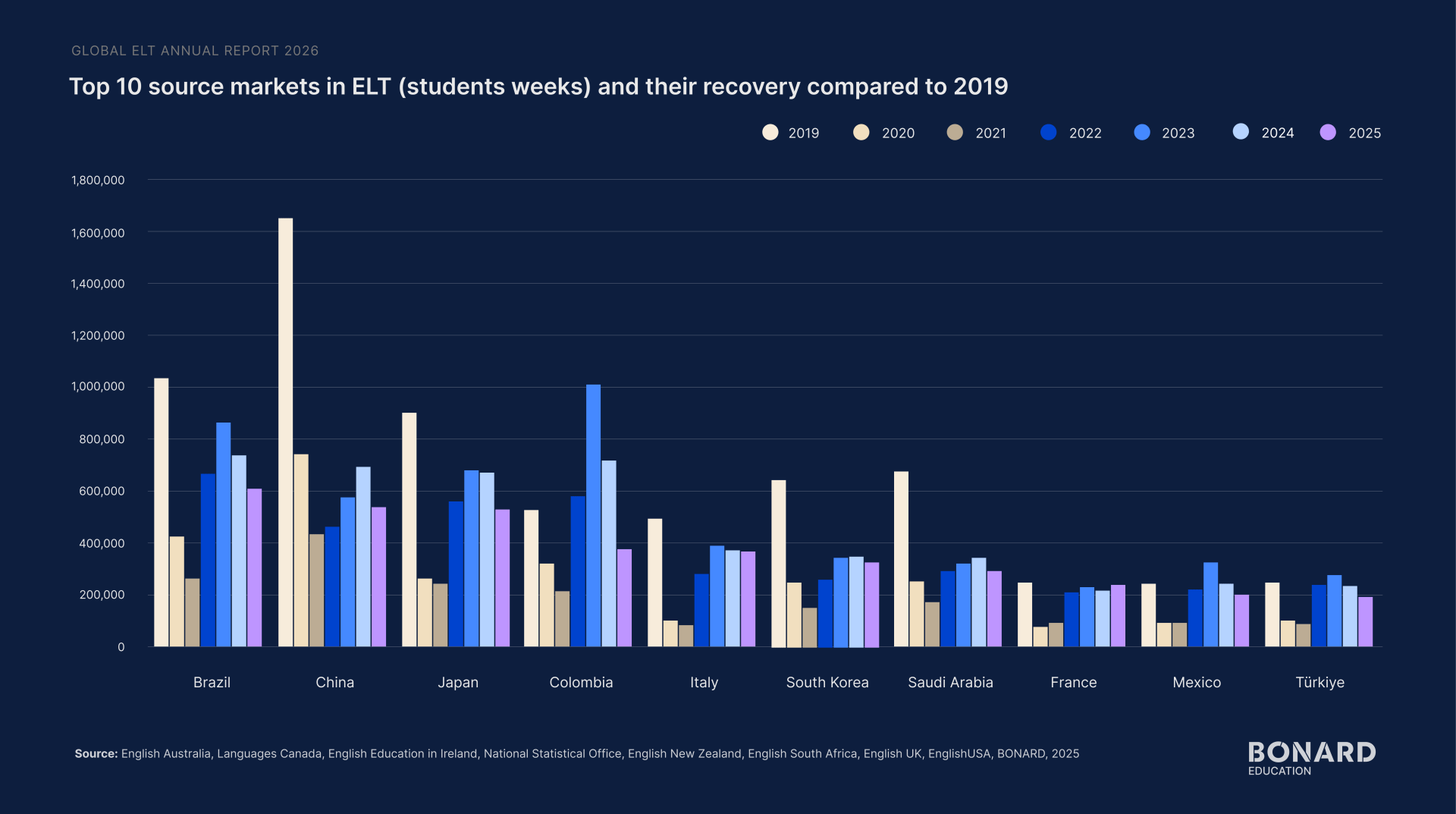
Brazil remained the largest source market (614,982 student weeks, despite an 18% fall). Saudi Arabia held its position among the largest globally at 300,320 student weeks, down 14%, though early signals point to a more challenging 2026. China contracted 22% to 543,641 student weeks and is now an increasingly junior-driven market — the clearest area of remaining opportunity there.
The regional picture diverges. Latin America saw some of the sharpest falls, with Colombia down almost 50%. Europe was considerably more stable: France grew 10%, while Italy and Germany declined only marginally. The opportunities that remain are more localised, smaller and often closer to niche than the broad growth markets of previous years.
What we heard from the sector
At the report launch, association leaders from across the eight destinations reflected on how recruitment strategy is changing. A consistent theme emerged: the shift from competing on volume and destination to competing on the student and the value of the experience.
On the affordability squeeze — and why, for some destinations, policy weighs even heavier than cost:

On the fundamental change in how providers recruit:

On the shift towards younger learners reshaping the business:

On what actually wins students in a lower-volume market:

On competing with cheaper destinations:

What this means for institutions
The outlook for 2026/27 is increasingly fragmented.
International student demand is not disappearing. It is being redistributed across study destinations, institutions, programme types and delivery models.
Recruitment leaders should therefore focus on five areas:
Plan by segment, not just by market. The old diversification question — which growing source market to add — matters less than matching source market, student segment and programme type to where demand is actually holding.
Build the junior proposition carefully. Juniors are the most resilient segment, but growth here does not replace the volume once generated by long-stay adults. Programmes tied to clear outcomes — academic preparation, STEM, measurable language progression — give parents a stronger reason to invest.
Compete on value and trust, not price. China and India will remain essential, but institutions need a broader and more balanced source market portfolio.
Protect margin as student weeks fall. Because weeks are declining faster than headcount, financial sustainability — not just enrolment numbers — needs to sit at the centre of planning.

Access the full report below
The Global ELT Annual Report 2026 covers all eight major destinations, the top source markets and their recovery against 2019, the adult–junior shift by destination, and a detailed outlook for 2026 and 2027 — including a dedicated analysis of China's junior ELT market.





CONTACT FORM
Report - Request form
Fill in the form to download the full report with key data and a one-year outlook for the English language sector

To further explore particular international education data and opportunities, please request to speak with one of our experts at education@bonard.com.